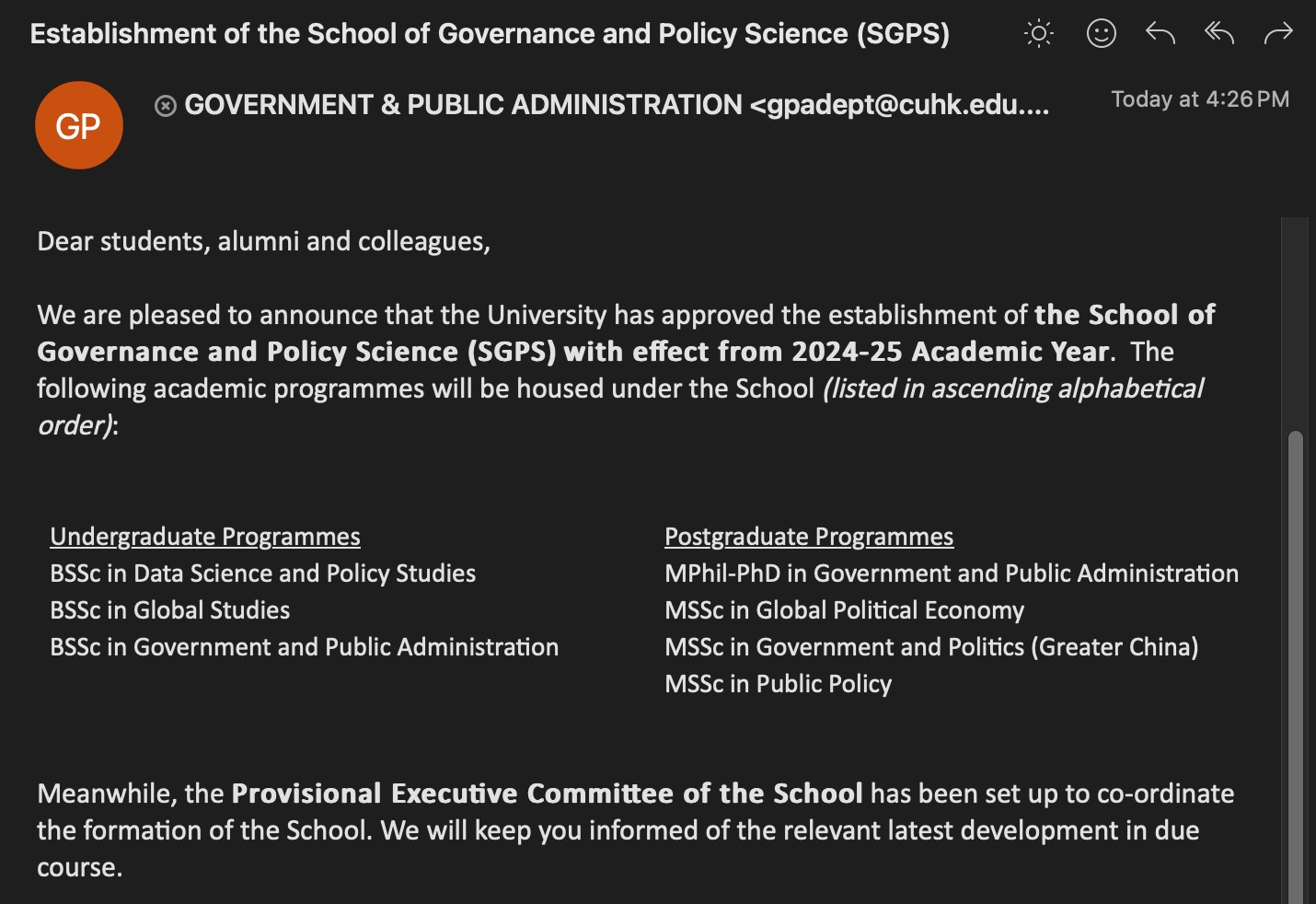
Two things happened today: 1) Professor Suisheng (Sam) Zhao from the University of Denver gave a talk today at the Chinese U of HK; 2) my department (Department of Government and Public Administration) has been merged into a new school (School of Governance and Policy Science).
1. Professor Zhao’s talk, here is my tweet on it:

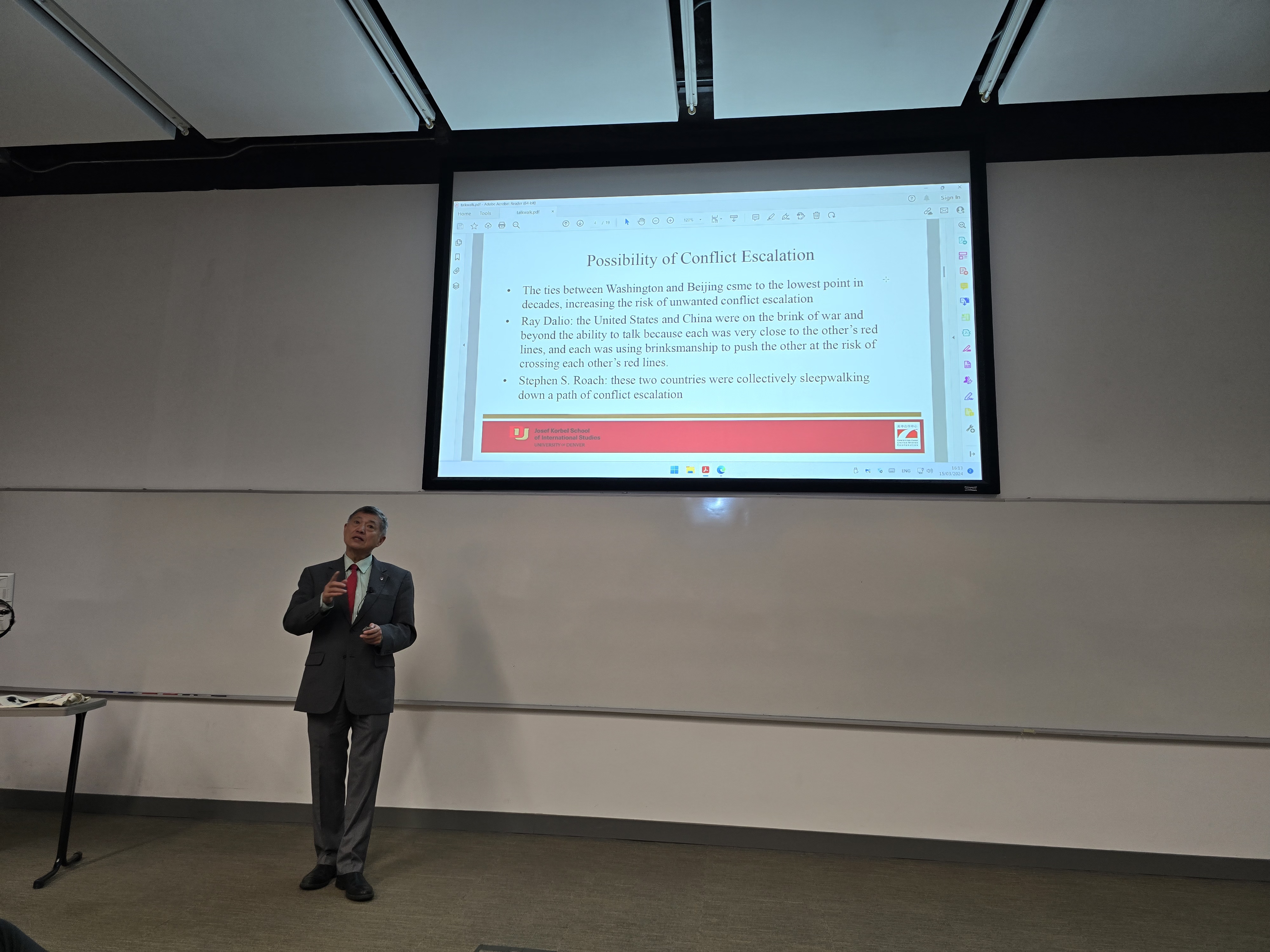
It was with great privilege and honour that I had the opportunity to attend a lecture hosted by Professor Suisheng Zhao (@SuishengZhao) today at The Chinese University of Hong Kong.
As a distinguished scholar renowned globally for his insightful research on China and Sino-US relations, as well as his role as the editor-in-chief of the esteemed Journal of Contemporary China, engaging with Professor Zhao’s thoughts was an invaluable experience.
The lecture, titled “Talk the Talk, Walk the Walk: Can Communication Facilitate Accommodation in the US-China Relationship?” presented a compelling discourse on the nuances of diplomatic communication and its potential to ameliorate the complex relationship between the United States and China. Professor Zhao’s analysis, rich in depth and characterised by his unique perspective, offered profound insights into the contemporary dynamics of this bilateral relations.
During the Q&A session, I was prompted by the discourse to pose two inquiries that had emerged spontaneously during the presentation. My initial question likened the Sino-US relationship to an “unfortunate marriage” that remains “indivorceable” due to multifaceted constraints, inquiring about Professor Zhao’s perspective on the potential future for this relationship, especially on his views regarding the often-debated Thucydides Trap, as articulated by Graham Allison, and the less-discussed Kindleberger Trap, posited by Joseph Nye. Professor Zhao addressed these concerns by challenging the inevitability of the Thucydides Trap, emphasizing its prohibitive costs (e.g., nuclear power and its consequences). Furthermore, when questioned about the prospect of the US and China pioneering a cooperative “G2” governance model for global affairs, although skeptical, he expressed a hopeful vision for mutual coexistence and collaboration between these two powers.
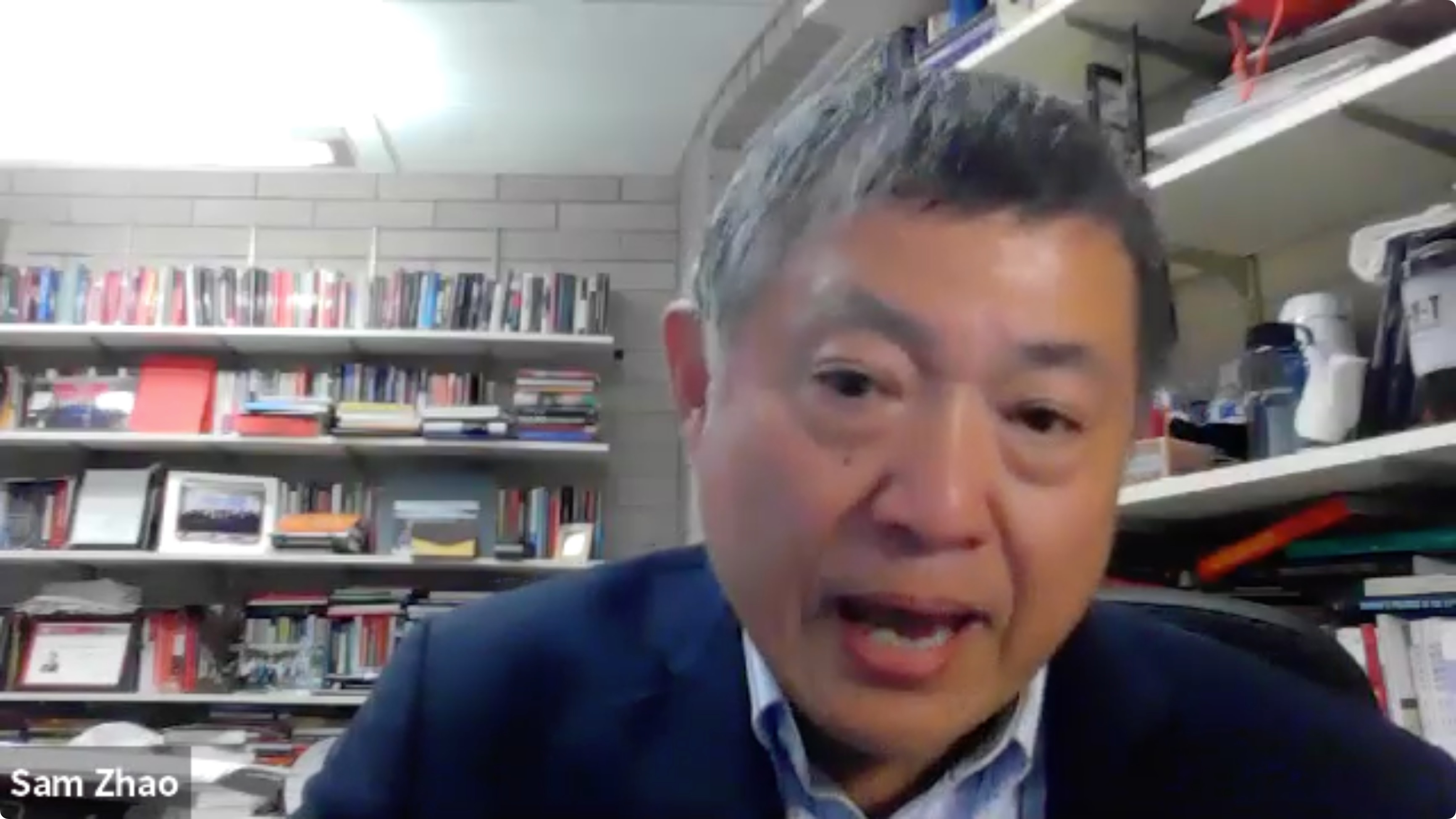
Reflecting on the afternoon’s discussion transported me back four years to another lecture by Professor Zhao, conducted via Zoom amid the pandemic, where the sentiment towards US-China relations was tinted with cautious optimism (pic 3 and 4). Witnessing the transformation of this relationship over the years, along with our perceptions, serves as a stark reminder of the fluid nature of international relations.
I eagerly anticipate further opportunities to engage with leading intellectuals in the field of International Relations, engaging in dialogues that shape our understanding of pivotal global issues. My special gratitude goes to the Centre for China Studies of the CUHK Faculty of Arts for facilitating this enlightening engagement.
2. My department has been merged, here is an email to inform us:

 Chen Chaofan Frank
You must be logged in to post a comment.